

Vancouver Island is stunning in all the best ways. We had planned for rain and were convinced that the island was choosing violence for our entire trip. Fortunately, it rained for about 15 minutes while we were driving across on our first day and never again. We saw the best of the Island and the beautiful locations with the best lighting. This has honestly never happened to me as a photographer and I was so excited! Here is a guide to the locations we stopped at and if you ask Emily, it was worth it for Tilly to have beach time and for me to take 400 sunset photos.
After we landed in Victoria, we grabbed the rental car and headed to Botanical Beach near Port Renfrew. We knew this would probably be our only chance to see this beach and that it would extend our drive to Tofino by about 2 hours, but it was worth the detour. At low tide, the sandstone shelf here reveals an extraordinary network of tide pools packed with sea stars, anemones, and urchins for anyone interested in macro and detail photography rather than just wide vistas. Bring a polarizing filter to cut the glare off the water’s surface so you can see down into the pools. Be sure to check tide tables carefully because this location is entirely tide-dependent. Showing up at the wrong time means flat rock and nothing else.

Suggested settings: For tide pool detail, use a macro lens or close-focus setting at f/8–f/11 for enough depth of field to keep small subjects sharp. ISO 200–400 in overcast conditions, and a polarizer rotated to minimize surface reflection. Shoot from directly above the pool when possible to reduce glare further.
The highway from Nanaimo to the west coast cuts through Cathedral Grove, home to some of the last old-growth Douglas fir on the island. The light here is completely different from the coast: soft, filtered, green-tinted. A tripod and a slower shutter speed will help you capture the scale of these trees, since wide apertures alone won’t convey just how massive they are. We chose not to stop since we had just been in the Redwood National Park a couple months ago. This is still a beautiful location to stop and take beautiful photos of the sun streaming through the trees.
Suggested settings: Use f/8–f/16 for front-to-back sharpness on tall trees. ISO 200–400 to compensate for the low forest light, and a tripod so you can shoot 1/10s or slower without noise. A wide-angle lens (16–24mm) helps convey scale; shooting straight up the trunk exaggerates height nicely.
Tofino itself is compact, but it has so many opportunities for photos. We chose to spend time at Chesterman Beach, Cox Bay, and Mackenzie Beach. We had no idea it is a well-known surfing location, and had a blast watching the swarms of surfers on the water at all times of day. The rock stacks provide unique orientation and there are numerous compositions I was able to play with.


Tofino is also a strong base for storm watching and whale watching tours. Both open up entirely different kinds of images from telephoto wildlife shots to wide, weather-heavy seascapes. We didn’t see any whales while we were there, but people in town reported they were spotted so be prepared.
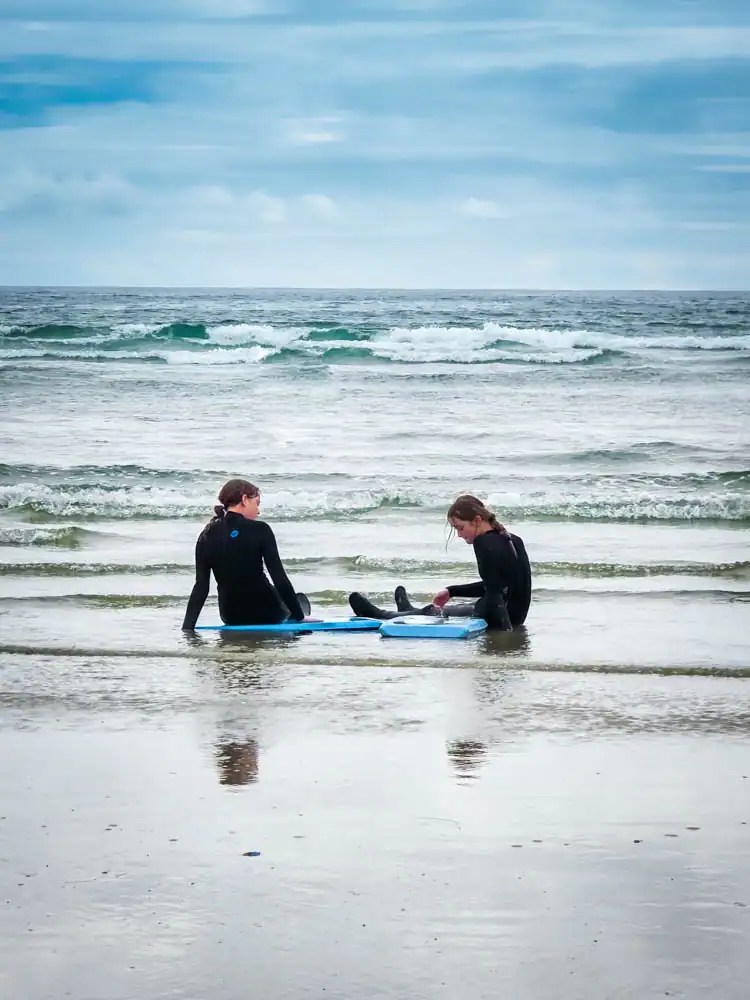

Suggested settings: For the glassy water at dawn, f/8, ISO 100–200, and a tripod for long exposures around 1–5 seconds. For whale watching from a boat, switch to a fast shutter (1/1000s or faster), continuous autofocus, and a telephoto lens (200mm+) to account for boat movement and unpredictable surfacing. For sunset photos, use a polarizing filter to deepen the sky and cut surface glare so the reflections read clearly. Because the water is calmer here, a shutter speed of 1/30s to 1/125s is usually enough. You don’t need the long exposures that rougher beaches demand.
Pacific Rim is the anchor of the whole region, and Long Beach is its centerpiece. This is a place built for wide-angle lenses: long sweeping sand, driftwood logs bleached and stacked by winter storms, and surf that rarely sits still long enough for a single “correct” exposure. Since dogs are only allowed on certain, limited sections of Long Beach due to the wolves we chose to explore the Rainforest Trails. You can read about the history of the dog and wolf interactions here.


A few things worth knowing:
Suggested settings: For crashing surf, try f/11–f/16, ISO 100, and a shutter speed between 1/4s and 2s on a tripod with a neutral density filter to smooth the water while keeping some texture in the waves. For freezing spray and action, go 1/1000s or faster instead. A graduated ND filter helps balance a bright sky against darker sand at sunset.
Ucluelet has a rougher, more rugged feel than Tofino, and the Wild Pacific Trail is the reason to bring your camera here. The trail hugs dramatic, wind-sculpted headlands with views straight out into open ocean. This is where you’ll find sea stacks, wind-bent shore pine, and, in winter, genuinely violent surf hitting the rocks. The lighthouse at Amphitrite Point is a classic foreground element, especially with a longer exposure to smooth out the waves.


Suggested settings: Use f/11–f/16 for depth across rocky foregrounds and distant headlands. ISO 100, and a shutter speed of 1–4 seconds (tripod plus ND filter) will smooth aggressive surf into mist. In high wind, brace your tripod low and shield the lens from spray between shots.
We started and ended our trip in Victoria. As the provincial capital, it has a different character entirely from the wild, weather-beaten west coast. The manicured gardens, Victorian architecture, and a working harbor right sit in the heart of downtown.
The Inner Harbour is the obvious starting point. The Parliament Buildings and the Fairmont Empress Hotel face each other across the water and both light up at dusk, making blue hour the best time to shoot here. Tthe building lights balance nicely against the darkening sky before it goes fully black. Seaplanes taking off and landing add movement to an otherwise static scene.

A short walk or drive away, Beacon Hill Park offers a gentler, greener contrast with totem poles, ponds, and views out over the Strait of Juan de Fuca toward the Olympic Mountains in Washington State on a clear day. If you have time for one more stop, Fisherman’s Wharf is worth a visit for its colorful floating houses and seals that gather around the docks, a good spot for both wide environmental shots and playful close-ups. But honestly you could spend your entire time walking around the Inner Harbour and Downtown and find plenty of photo spots.
Suggested settings: For the Inner Harbour at blue hour, use f/8–f/11, ISO 100–200, and a tripod for exposures of 1–10 seconds to let the building lights and sky both register well; a two-second timer or remote shutter helps avoid camera shake. For Butchart Gardens, a mid-range aperture (f/5.6–f/8) keeps flowers sharp while still separating them softly from the background, and overcast days actually work in your favor by giving even, saturated color without harsh shadows. At Fisherman’s Wharf, a slightly wider aperture (f/4–f/5.6) helps isolate colorful details against a busy background, and a fast shutter (1/500s+) will freeze any seal activity in the water.
Vancouver Island doesn’t need much help looking photogenic but showing up at the right tide, in the right season, and with a little patience will make the difference between a nice shot and a memorable one.

** Written by Kira**